
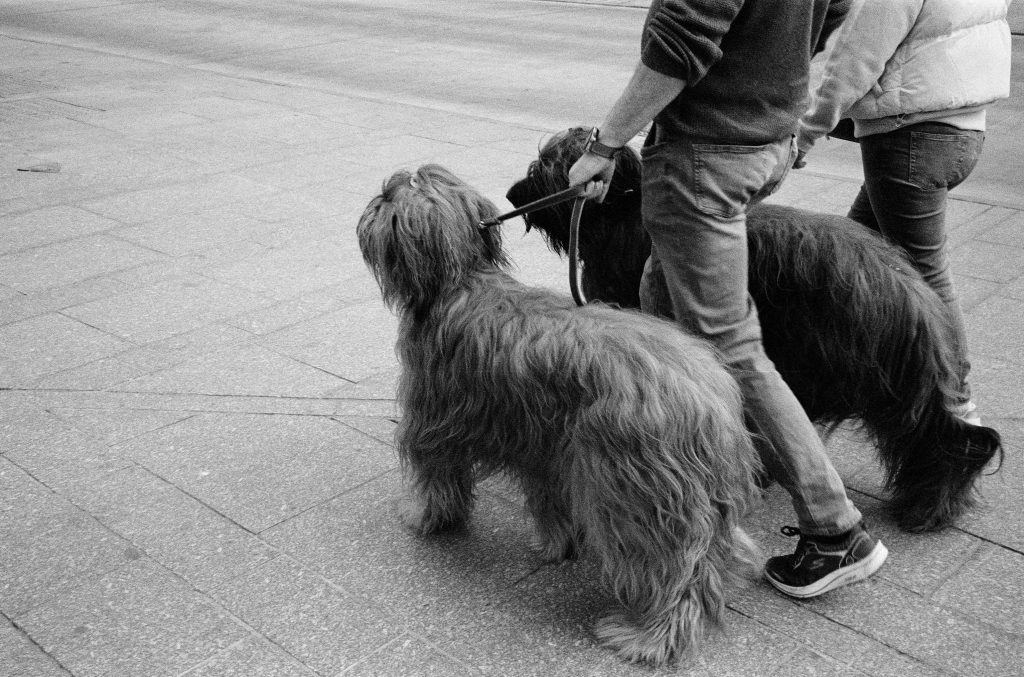
A new client walks into your space with a dog pulling in every direction. The dog’s tongue is out, their eyes wild. There is an ungodly sound coming from their throat. That sound is a mixture of excitement and the pressure of the collar against their own throat from pulling. You can forget about the dog being able to learn or listen.
Behind the dog is an exasperated owner with their arms outstretched in front of them, footing unsteady and a flushed face caused by effort and embarrassment. They came to you for help. At that moment, they can barely stay on their feet.
Your job is to teach this new client that the leash is more than a safety tool. Once they understand that, everything you teach afterward becomes easier.
Safety
Safety is the most obvious reason people use a dog leash. A dog that is still learning does not yet have the reliability to respond to commands in every situation. The leash prevents the dog from running into traffic and approaching unknown dogs or people. Basically, it prevents a dog from getting into dangerous situations while their brain is still learning new habits.
Keeps the Dog in the Learning Zone
Dogs learn when they are close enough to engage with their handler. A leash keeps the dog at a close enough distance where you can communicate clearly verbally and through body language. When dogs wander off, the learning opportunity is gone.

Prevents Rehearsal of Unwanted Behaviors
Every time a dog practices an unwanted behavior, the behavior gets stronger. Whether the behavior is jumping, running away, chasing wildlife, each repetition, good or bad, forms the dog’s future behavior. The leash is a management tool that prevents the dog from rehearsing mistakes while they are learning.
Build Reliability Before Freedom
An off-leash dog in an open environment has hundreds of distractions competing for their attention. The leash narrows the dog’s world just enough to help them focus on what you are teaching. Think of it as creating a calm classroom environment rather than trying to teach in the middle of a busy playground.
When dogs are too stressed, too excited or too distracted, we refer to it as “over threshold”. Dogs cannot learn properly when they are over threshold. A leash helps keep dogs under threshold by allowing us to give them space from things that trigger these emotions. In turn, it permits dogs to learn again.
Freedom is a privilege that must be earned rather than given by default. A leash allows you to confirm the dog truly understands a command before testing it in a real-life situation. Skipping this step is one of the most common reasons owners say, “He does it at home, but not outside.”
The leash allows you to give information without relying solely on verbal cues the dog hasn’t fully learned yet. You can guide a dog through a behavior with a gentle leash cue (leash pressure and release) before the verbal cue has been fully conditioned.
Builds Trust Between Dog and Handler
Contrary to what some believe, a leash does not restrict a dog’s spirit. Instead, it builds confidence. When a dog knows there is a calm, steady handler guiding them through new situations, they learn to trust the process. That trust becomes the foundation for off-leash reliability later on.
Protects Others
Even the friendliest dog can cause harm. Any dog can knock a child down, scratch an elderly person or trigger a reactive dog. During the learning phase, the leash ensures the dog cannot put others at risk while their impulse control is being developed.

A leash is not a permanent restriction. It is a temporary bridge between where the dog is today and where you want them to be. Once a dog has learned behavior in various locations, and around different levels of distraction, you can now remove the leash in safe environments, allowing the dog more freedom indoors and while playing in a secure yard.
As far as walking without a leash, there are some dogs who will always chase wildlife and others who startle easily, so not every dog should be off-leash in public. There are also leash laws in different towns within the United States preventing dogs from walking leash free. To learn a bit more on how to use a leash properly, read our blog “Seven Human Behaviors That Confuse Dogs.”
It is important to remind your clients that keeping their dog on leash is not a punishment. It is responsible training.

To learn more on training a dog to walk in a heel or loose leash, visit ISCDT.com. Our dog trainer course includes lessons on training a dog to walk on a loose leash without using pressure or corrections.